Comprehensive Analysis of Drywall Screws: Uses, Types, Buying Guide and Installation Tips [2026 Latest]
In architectural decoration and home improvement construction, drywall screws are indispensable core fasteners specially designed for the installation and fixation of gypsum boards, light partition walls, suspended ceilings and other scenarios. With convenient constructability and stable connection performance, they have become the first choice for decorators, decoration companies and self-renovation owners. Many people often confuse drywall screws with ordinary self-tapping screws when purchasing or using them, and also struggle with how to choose specifications and avoid pitfalls. This guide comprehensively answers all core questions about drywall screws, helps you quickly select and use drywall screws correctly, and reveals the latest trends in the drywall screw industry in 2026.
I. What is a Drywall Screw? Understand Its Core Uses in One Article
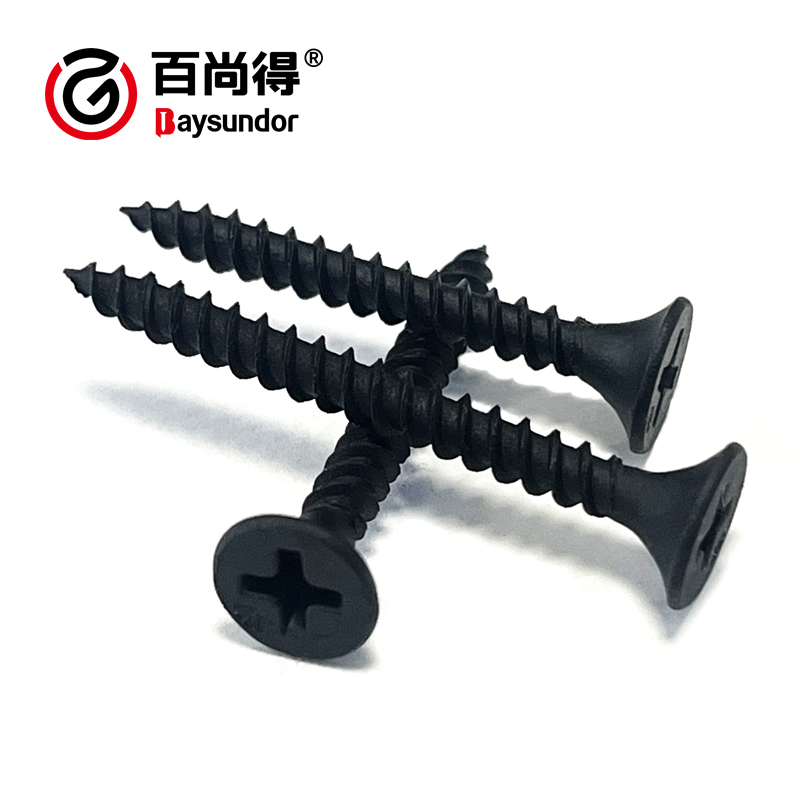
Drywall screws, also referred to as drywall screws in English, are special fasteners designed specifically for gypsum board (drywall) installation. Their most prominent appearance feature is the trumpet-shaped head. With a scientific structural design, they can efficiently connect gypsum boards and keels, avoiding problems such as board cracking and loose fixation during construction. Compared with ordinary self-tapping screws, they focus more on adapting to the fixation of lightweight boards and are “invisible but crucial” decoration accessories in home and commercial decoration.
The core uses of drywall screws are mainly concentrated in the following scenarios, covering most decoration needs and also the core direction of users’ high-frequency searches:
- Gypsum board installation: Whether it is a single-layer or multi-layer gypsum board, drywall screws are the first choice for fixing to light steel keels or wooden keels, which can ensure the board is flat, firm and not easy to loosen;
- Partition wall system: In the construction of gypsum board partition walls, they are used to connect the panel and the framework, ensuring the stability and load-bearing capacity of the partition wall, suitable for the construction of partition walls in various spaces such as residences, offices and shops;
- Suspended ceiling system: When installing a gypsum board suspended ceiling, drywall screws are used to fix the gypsum board to the ceiling keel, taking into account both firmness and aesthetics, and avoiding deformation and falling off of the suspended ceiling in the later stage;
- Other scenarios: They can be used for fixing lightweight materials such as wood boards and plywood, suitable for the installation of small decorative components, furniture backboards, etc., with extremely strong practicality.
With the popularization of prefabricated buildings in 2026, the usage of drywall screws continues to increase. Especially in large-scale public construction projects, the usage of drywall screws per square meter has increased by about 15% compared with previous years, making them an indispensable core accessory in the architectural decoration field.
II. Common Types of Drywall Screws: Choose the Right One According to Usage to Avoid Waste
Many users are confused by terms such as “double-threaded, single-threaded, galvanized, phosphated” when purchasing. In fact, the classification of drywall screws is very simple, mainly divided by thread type, surface treatment and material. Different types are suitable for different scenarios, and accurate selection can improve construction efficiency and extend service life.
1. Classification by Thread Type (The Most Core Classification)
- Double-threaded fine-tooth drywall screws: The thread is double-threaded, with fast driving speed and good lubricity. They are suitable for connecting gypsum boards with metal keels with a thickness of no more than 0.8mm. They are the most commonly used type in indoor decoration, suitable for most light steel keel suspended ceiling and partition wall construction;
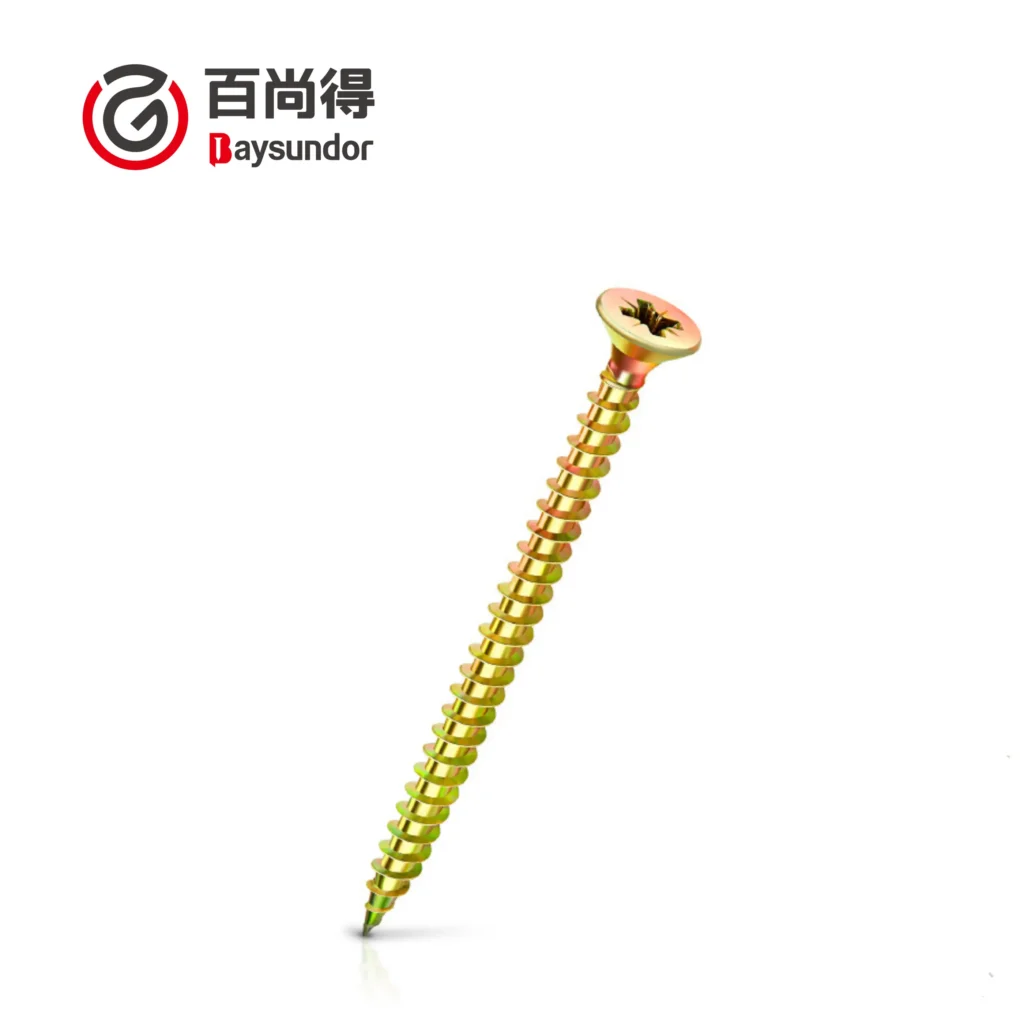
- Single-threaded coarse-tooth drywall screws: The thread is wider, with faster driving speed. They will not damage the wood structure when drilled into wood, so they are more suitable for connecting gypsum boards with wooden keels. They are widely used abroad and are gradually popularized in China, especially suitable for home decoration wooden keel scenarios;
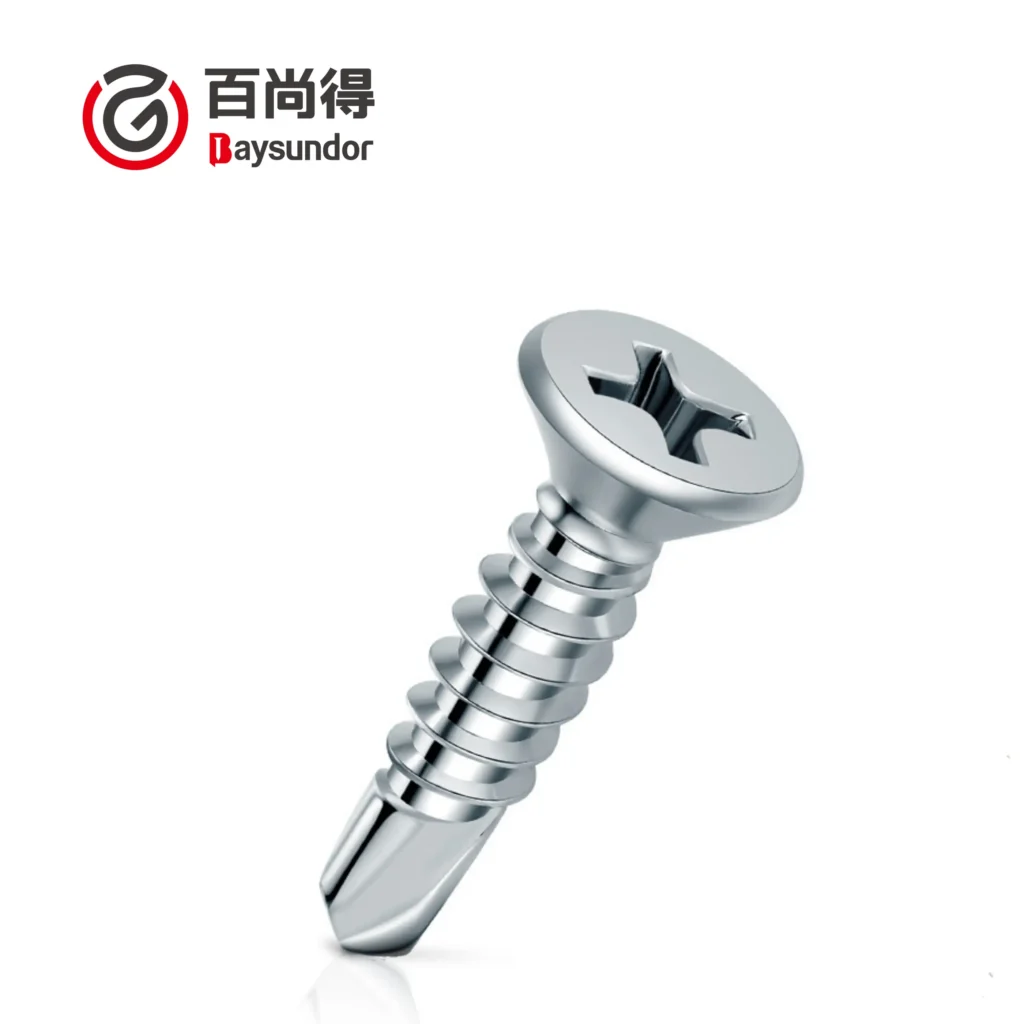
- Self-drilling drywall screws: Equipped with a built-in drill bit design, no pre-drilling is required, and they can be directly drilled into metal keels with a thickness of no more than 2.3mm. The construction efficiency is extremely high, suitable for commercial projects with tight construction periods, available in black phosphating and yellow zinc plating.
2. Classification by Surface Treatment (Affects Rust Resistance)
- Black phosphated drywall screws: The surface is treated with black phosphating, which has a certain lubricity and slightly better driving speed. They are suitable for ordinary indoor dry environments, with high cost performance and are the first choice for home decoration;
- Blue-white zinc/yellow zinc drywall screws: Their rust resistance is better than that of black phosphated ones, and their natural color is light. After decoration, painting and puttying are not easy to cause discoloration. They are suitable for humid environments (such as kitchens, bathrooms) or scenarios with high aesthetic requirements. The rust resistance of the two is similar, and the main difference lies in usage habits and preferences;
- Stainless steel drywall screws: Made of 304 or 316 stainless steel, they have extremely strong corrosion resistance. They are suitable for humid and rust-prone scenarios such as outdoor areas, bathrooms and kitchens. Although the unit price is higher, they can prevent the nail head from rusting and penetrating the wall in the later stage, extending the decoration life.
3. Classification by Material (Affects Load-bearing Capacity and Durability)
- Carbon steel drywall screws: Made of high-strength carbon steel material, they have high hardness and good toughness, and are not easy to bend or break. They are suitable for ordinary indoor decoration, with high cost performance and are the most mainstream type in the market. The tensile strength can reach 520-580MPa, meeting most decoration needs;
- Stainless steel drywall screws: As mentioned earlier, they are mainly suitable for humid and corrosive environments. 304 material can meet most humid scenarios, and 316 material is suitable for outdoor or strong corrosive environments. They conform to the green and environmental protection trend, and the usage ratio of recycled stainless steel is also constantly increasing.
III. Drywall Screw Buying Guide: Avoid 3 Pitfalls and Choose the Right One
When purchasing drywall screws, the core is to focus on “scenario, specification and quality”. Many people choose the wrong specification or buy inferior products for cheap, leading to loose boards, rusty nail heads and wall cracks in the later stage. The following 4 key points help you purchase accurately, and also cover high-frequency search terms such as “how to choose drywall screws” and “drywall screw specifications”.
1. First Look at the Usage Scenario to Determine the Material and Surface Treatment
- Ordinary indoor dry environments (living rooms, bedrooms, studies): Choose carbon steel drywall screws with black phosphating or blue-white zinc treatment, which have high cost performance and meet daily fixation needs;
- Humid environments (kitchens, bathrooms, balconies): Prioritize stainless steel drywall screws or carbon steel drywall screws with blue-white zinc/yellow zinc plating, and do a good job in rust prevention to avoid rust in the later stage;
- Outdoor or strong corrosive environments: Must choose 316 stainless steel drywall screws or products with special anti-corrosion coatings to resist the erosion of wind, sun and rain and extend the service life;
- Prefabricated buildings and large-scale commercial decoration: Choose high-strength carbon steel or stainless steel drywall screws, which need to meet the requirements of earthquake resistance and tensile strength, with torque strength ≥ 3.2N·m and tensile pull-out force ≥ 1.5kN, complying with industry standards.
2. Accurately Match Specifications: Choosing the Right Length and Diameter is Key
The specifications of drywall screws mainly depend on length and diameter. The core principle is “length adapts to the thickness of the board, and diameter adapts to the load-bearing demand”. The following is a reference for the most commonly used specifications in 2026, suitable for most decoration scenarios, which can be directly referred to for purchase:
Specification Model | Length (mm) | Diameter (mm) | Applicable Scenarios |
M3.5×25 | 25 | 3.5 | Fixing 9.5mm thick single-layer gypsum board to light steel/wooden keels |
M3.5×32 | 32 | 3.5 | Fixing 12mm thick single-layer gypsum board |
M4.2×38 | 38 | 4.2 | Fixing double-layer gypsum boards or thicker boards |
M4.2×50 | 50 | 4.2 | Fixing special thick boards, multi-layer boards or light steel keels |
Supplementary tips: The length of the drywall screw is recommended to be about 2.5 times the thickness of the gypsum board, or at least 10-15mm longer than the thickness of the fixed material, to ensure firm fixation, avoid looseness caused by insufficient length, or penetration of the board caused by excessive length. In terms of diameter, 3.0-3.5mm is selected for ordinary gypsum boards, and 4.2mm or more is selected for thicker boards or scenarios with high load-bearing requirements.
3. Pay Attention to Quality Details and Avoid Inferior Products
- Check the thread: The thread should be clear and uniform in depth. Too shallow a thread has insufficient grip, and too deep a thread will weaken the strength of the rod and easily cause breakage; uniform thread spacing can make the force more uniform and enhance fixation firmness;
- Check the nail head: The trumpet head design has a large contact area, which can disperse pressure and avoid gypsum board cracking; the countersunk head drywall screw is flush with the board surface after installation, which is convenient for subsequent puttying and painting, and the appearance is cleaner;
- Check the brand and certification: Prioritize well-known brands (such as Knauf, Bosch, Stanley), as their product quality is more guaranteed. Products certified by the ISO 9001 quality management system are more trustworthy in terms of safety and reliability. Avoid buying unbranded and uncertified inferior products, which are easy to bend and rust and have potential safety hazards;
- Check the packaging: Regular products have complete packaging, with clear specifications, materials and surface treatment methods marked, which is convenient for verification and storage. Avoid buying bulk and unmarked products.
4. Choose the Right Packaging Quantity on Demand: Avoid Waste or Troubles in Replenishment
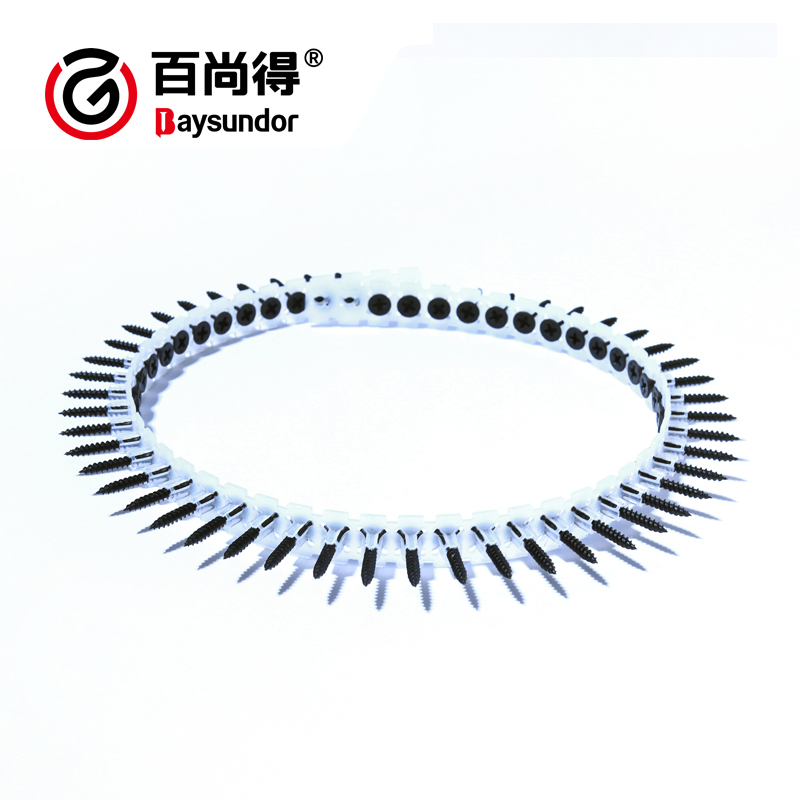
Choose the appropriate packaging of drywall screws according to the decoration project volume. For small-scale home decoration (such as the suspended ceiling and partition wall of a single room), small packaging (1000 pieces/package) can be selected. For commercial decoration or large-scale decoration, large packaging (5000 pieces/package, 10000 pieces/package) can be selected. On the premise of meeting the demand, take into account cost performance, avoid waste or increase costs and time costs due to multiple replenishments.
IV. Correct Installation Skills of Drywall Screws: Easy for Beginners to Operate, Avoid Construction Mistakes
Choosing the right drywall screws and installing them correctly are equally important. Many decoration problems (such as board cracking, exposed nail heads, looseness) are caused by improper installation. The following are detailed installation steps and skills, covering high-frequency search terms such as “drywall screw installation method” and “drywall screw installation precautions”, which are easy for beginners to master.
1. Preparation Before Installation: Adaptation of Tools and Materials
- Tool selection: Prioritize the use of a lithium-ion drill with torque adjustment, and preset the torque to 5-7 gears (medium strength) to avoid breaking the board due to excessive torque; match it with a special drywall screw bit. If the bit has no depth limiter, wrap tape around the rod to mark the driving depth (the conventional scenario is board thickness + 10-15mm); auxiliary tools include a pencil (for marking nail positions), a level (for ensuring the board is flat), a tape measure (for controlling spacing), and sandpaper (for repairing burrs);
- Material inspection: Confirm that the specifications and materials of the drywall screws are suitable for the scenario, the surfaces of the gypsum board and keel are not damaged, and moisture-proof treatment should be done in advance in humid environments to avoid rust in the later stage.
2. Core Installation Steps: Standard Operation to Avoid Mistakes
- Scientific positioning: The nail should be no less than 15mm away from the edge of the gypsum board to prevent the board from cracking; the spacing in the middle of the board should be controlled within 300mm to form uniform support; a nail should be fixed 50-100mm away from the joint on both sides of the board joint, distributed symmetrically to avoid joint misalignment; it is recommended to adopt a plum-blossom staggered layout to disperse the force on the board and reduce deformation;
- Accurate driving: The rotation speed of the electric drill is controlled at 1000-1500 rpm. High-speed rotation is easy to tear the paper surface; the bit should be kept 90° vertical to the board surface. Oblique driving will expand the nail hole and affect fixation strength; first quickly pre-fix (with the nail head touching the board surface), then slowly press in at low speed to ensure that the nail head sinks 0.5-1mm into the board surface, forming a smooth pit without breaking the paper surface or exposing the nail head;
- Rust prevention treatment: All nail heads need to be painted with zinc chromate or epoxy anti-rust paint. After the paint dries, fill the pit with caulking gypsum to avoid the nail head rusting and penetrating the wall in the later stage to form rust spots. In humid environments, additional silicone sealant should be applied to enhance the waterproof effect.
3. Installation Skills for Special Scenarios: Break Through Difficulties and Improve Stability
- Connection between light steel keel and gypsum board: Nails must be fixed within 30mm of the keel edge, and the spacing of nails on each keel is ≤ 200mm, 50% denser than in conventional scenarios; if the keel thickness is ≥ 1.2mm, a 3mm drill bit should be used for pre-drilling first to prevent the nail tip from slipping or the keel from deforming;
- Fixing of high-density boards: For multi-layer boards and high-density boards, it is recommended to use single-threaded coarse-tooth drywall screws with thicker threads and stronger biting force; adjust the electric drill torque to 8-10 gears and drive in twice to avoid board cracking caused by instantaneous impact;
- Installation in humid environments: In addition to using stainless steel drywall screws, the nail holes need to be treated with double waterproofing (anti-rust paint + sealant). After installation, check the sealing of the board joints to avoid water vapor seeping into the nail holes.
4. Common Installation Mistakes: Avoid in Time to Reduce Rework
- Nails too long/too short: Too long nails are easy to penetrate the board and deform the keel, while too short ones are not firm. Strictly follow the principle of “board thickness + 10-15mm” to choose the length;
- Repeated nailing at the same position: This will cause the board to crack. After missing the mark, reposition 20mm beside the original hole, fill the old hole with wooden plugs before construction;
- Excessively high electric drill speed: This will cause overheating of the nail head and peeling of the coating. It is recommended to grind the tip of the bit every 50 nails to remove metal debris and avoid slipping;
- Ignoring rust prevention treatment: Especially in humid environments, omitting the rust prevention step will lead to the nail head rusting in the later stage, penetrating the wall and affecting the appearance and service life.
V. Common Questions and Answers About Drywall Screws: Solve All Your Puzzles
We have collected 4 frequently asked questions by users, covering popular search terms such as “difference between drywall screws and self-tapping screws” and “drywall screw rust prevention”, to quickly answer your doubts and improve the practicality and user stay time of the article.
1. What is the difference between drywall screws and self-tapping screws?
The two are similar in appearance, but there are obvious differences in usage and characteristics to avoid confusion: ① Usage: Drywall screws are mainly used in scenarios such as gypsum boards, light partition walls and suspended ceilings; self-tapping screws are mainly used for fixing soft metal or non-metallic materials; ② Characteristics: Drywall screws have a trumpet head shape, suitable for lightweight boards; self-tapping screws have high locking performance and low screwing torque, which can replace some machine screws; ③ Classification: Drywall screws are divided into double-threaded fine-tooth and single-threaded coarse-tooth according to threads; self-tapping screws are classified according to the shape of the nail head, with more types (round, hexagonal, flat head).
2. What to do if the drywall screw is rusty?
If the nail head is slightly rusty, first polish it with sandpaper to remove rust, then apply anti-rust paint and fill the pit; if the rust is severe and has penetrated the wall, remove the old nail, re-nail 10mm beside the original hole, fill the old hole with gypsum putty, and re-perform rust prevention and surface treatment; in humid environments, it is recommended to directly replace with stainless steel drywall screws to avoid rust from the root.
3. Can drywall screws be reused?
It is not recommended to reuse drywall screws. They are disposable fasteners. After disassembly, the thread will be damaged and the grip will decrease. Reuse will lead to loose fixation and potential safety hazards; moreover, the anti-rust coating on the surface of reused drywall screws will fall off, making them easy to rust, which affects decoration quality and service life.
4. What are the new trends in the drywall screw industry in 2026?
With the popularization of prefabricated buildings and the advancement of green environmental protection policies, the drywall screw industry is developing towards high performance, intelligence and greenization: ① The application of high-strength materials is more extensive, with tensile strength increased to more than 520MPa, adapting to the requirements of earthquake resistance and high load-bearing; ② Green manufacturing has become the mainstream, with the usage ratio of chrome-free passivation and recycled stainless steel increased, and the carbon footprint reduced; ③ Intelligent production is popularized, with the product qualification rate increased to more than 99.8%, and installation efficiency further improved; ④ The adaptability to segmented scenarios is enhanced, and the demand for special drywall screws for humid, outdoor and other scenarios is growing.
VI. Summary: Choose the Right Drywall Screws for More Worry-free and Durable Decoration
Although drywall screws are small, they are key accessories in decoration that “affect the whole body”. Choosing the right type and specification and mastering the correct installation method can avoid problems such as loose boards, rust and cracking in the later stage, extend the decoration service life, and improve construction efficiency. Whether you are a decorator, a decoration company or a self-renovation owner, mastering the drywall screw knowledge in this article can help you easily avoid pitfalls in purchase and installation and accurately meet your needs.
We focus on the production of high-quality drywall screws, covering all types and specifications, using high-strength materials and advanced surface treatment technology, complying with 2026 industry standards, suitable for various scenarios such as home decoration, commercial decoration and prefabricated buildings, with guaranteed quality and high cost performance. If you have any questions about drywall screw purchase, specification matching, installation skills, etc., please feel free to consult us. We will provide you with professional solutions to help you complete the decoration construction efficiently.
Hot-Selling products